
Palace of the Constitutional Court of the Republic of Slovenia
Chamber of Commerce, Craft, and Industry
Architecture: Viljem Treo (1881),
Jože Plečnik, France Tomažič (1927)
Year of construction: 1881 and 1925–1927
In planning the renovation and overseeing the construction, Plečnik worked closely with his first assistant, France Tomažič (1899–1968), who is the only person credited on the construction plans and is also named as the building’s architect on the plaque by the entrance. In this way, Plečnik provided his students with their first professional references and helped them advance in their careers.
As part of the renovation of the Chamber of Commerce, Craft, and Industry, several rooms were remodelled according to Plečnik’s plans, the previously unused attic was converted into office space, and most significantly, a new wing with a monumental staircase was added to the courtyard side of the building. The Chamber’s representative rooms were also fitted out. Due to the attic conversion, a row of rectangular windows was added on the exterior between the roof cornice and the window pediments of the first floor. To reduce the sense of visual overload caused by this intervention, Plečnik had the façade painted in uniform brown tones. This effect was undone during the 1990 renovation, when the architectural elements were painted grey and the wall surfaces pink. In the most recent renovation, the uniform colour scheme was restored.
The courtyard façade of the annex features striped rustication resembling log construction. Plečnik used a similar decorative approach for the southern exterior of the Bull Staircase at Prague Castle (1928–1931). In the courtyard, there is also a fountain designed by the architect, with a rectangular column topped by an imitation vase. Nearby originally stood a stone column on a pedestal, which was later moved to the courtyard of the building at 4 Prešeren Street.

On the first floor, in front of the entrance to the assembly hall, attention is drawn to a colourful coffered ceiling, created under the influence of Semper’s writings. By the entrance to the hall stands a lamp, reminiscent in design of the Solomonic columns of Bernini’s baldachin above the main altar of St. Peter’s Basilica in Rome. Plečnik had originally envisioned it in reddish Hotavlje marble, but later replaced the already crafted column with a lamp made of tombac, produced at Mašek’s foundry in Prague. This is the only furnishing not made by local craftsmen. The original marble column is now located in Trieste, while the wooden model of the lamp decorates the villa of Czech architect and Plečnik’s close collaborator Otto Rothmayer (1892–1966) in Prague.
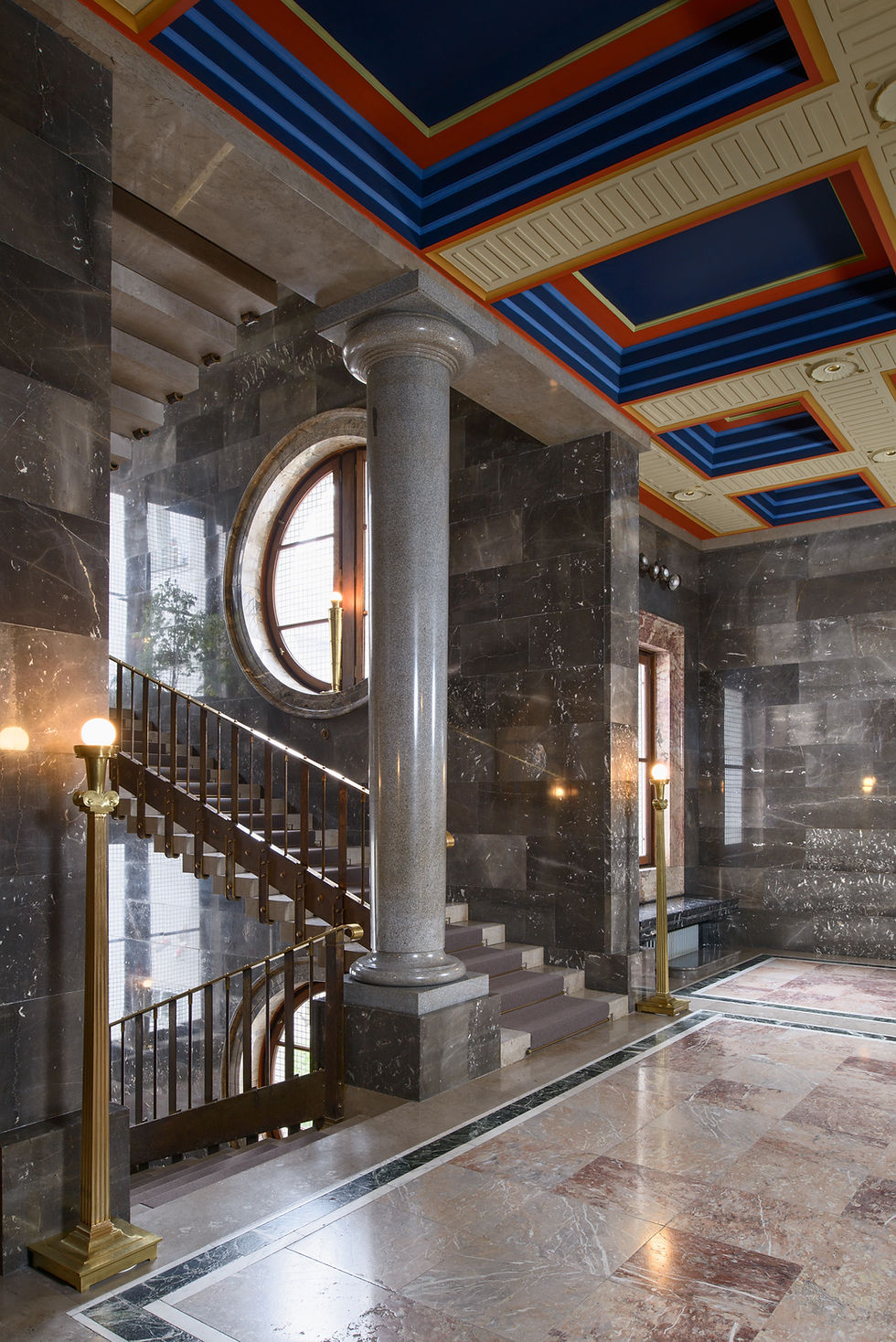
Staircase, view from the front of the large hall, photo by Miran Kambič
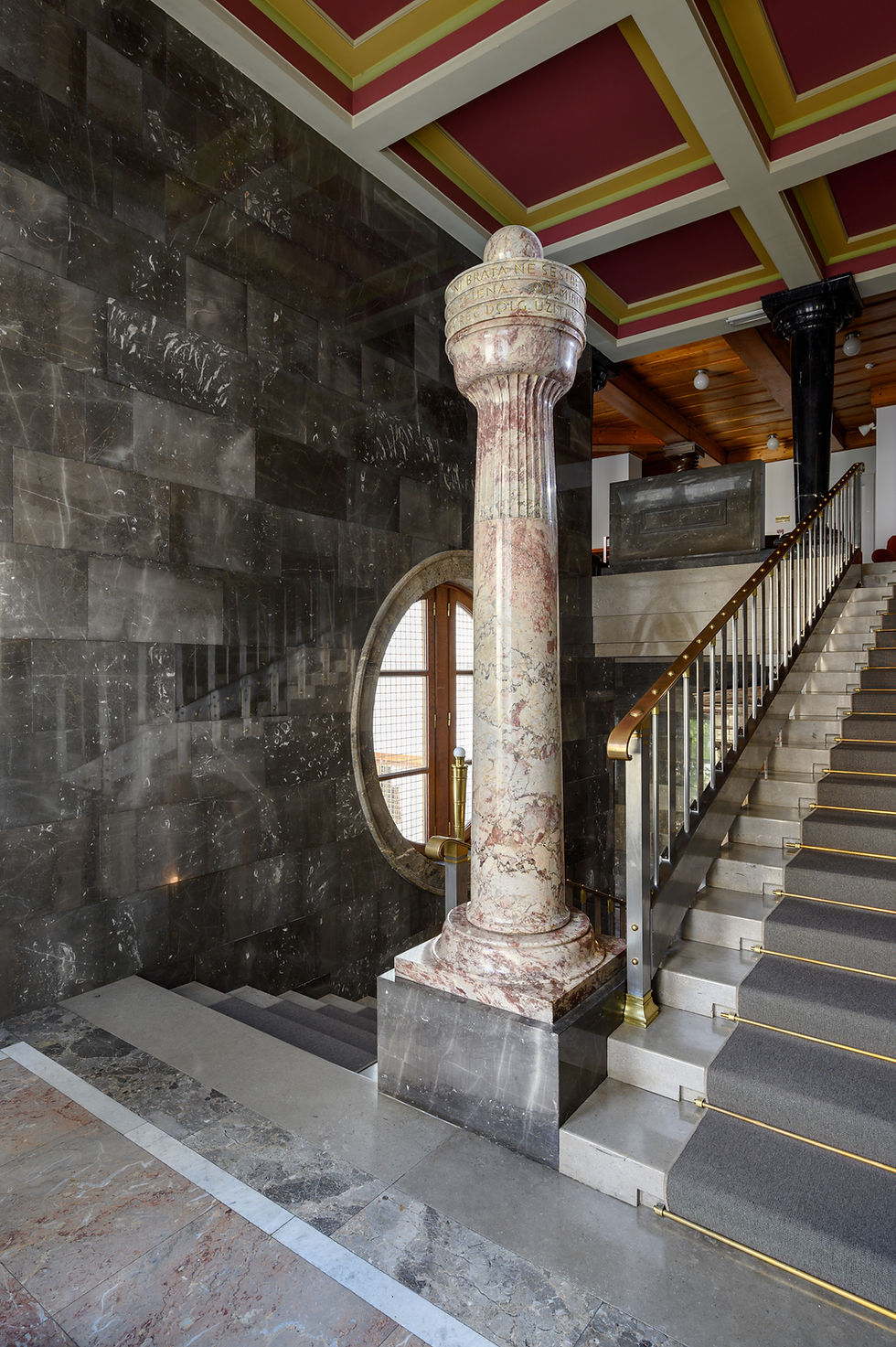
Pillar on the rear landing, photo by Miran Kambič
Plečnik’s central intervention was the creation of a monumental staircase. In this project, the architect experimented for the first time with various types of local stone and their aesthetic effects. At the same time, he insisted that the craftsmen carry out the work with the highest precision, which had a significant impact on the development of applied arts in Slovenia. The construction did not go without complications. A stonemasonry company from Celje, commissioned by Ivan Ogrin (1875–1946)—a builder and vice-president of the Chamber who oversaw the construction—began cutting the stone before the detailed plans were completed. As a result, Plečnik was forced to demand that construction be halted. The staircase, made from Nabrežina stone, was anchored on only one side, which led the building inspection to raise concerns about insufficient structural support and demand reinforcement. Plečnik responded by adding a supporting structure, consisting of a polished steel beam from which individual steel clamps were extended to hold each step, thereby ensuring the staircase's stability.
The assembly hall itself is distinguished by a richly decorated ceiling, whose longitudinal layout suggests a three-nave space. This central, ceremonial space contains no chandeliers; instead, light bulbs are placed in the centre of the ceiling coffers. The wall panelling and parquet flooring with deltoid motifs also contribute significantly to the room’s lavish appearance. The hall’s furnishings show clear parallels with the furniture Plečnik designed at the same time for Prague Castle. The monumental armchairs are stylistically based on a chair type Plečnik designed in 1926 for the wardrobe of Czechoslovak President Tomáš G. Masaryk (1850–1937), which he later adapted for the library of engineer Matko Prelovšek (1876–1955) in Ljubljana. The assembly hall tables originally had light-coloured Carrara marble tops, which helped brighten the room. These tables, along with the seating set that once stood in the second-floor corridor, were lost during World War II. Apart from the hall, the original furnishings are only partially preserved in the former director’s offices. Of the small consultation room’s interior, only the wooden ceiling and wall panelling remain.

The staircase walls are clad in Podpeč limestone, creating a dark but solemn atmosphere—a design strategy Plečnik would later use again in the staircase of the National and University Library (1936–1941). Natural light enters the space through a circular window and glazed walls at the landings. The pillar is the main motif of Plečnik’s design, appearing in various forms: from monumental granite columns on the ground floor and a landing column between the first and second floors with a uniquely shaped capital featuring a sphere, wrapped in bands bearing proverbs, to dark marble Minoan columns at the top of the staircase, and manneristically designed wooden columns on the attic landing. Plečnik had originally intended the load-bearing columns to be Tuscan, but due to a measurement error made in his absence, he was forced to alter the design and opt for Minoan columns instead. In line with the principles of Gottfried Semper (1803–1879)—a German architect whose theoretical writings deeply influenced Plečnik’s understanding of architecture—the ceilings and floors of each story are more richly designed than the walls. The portals vary in form, but collectively they maintain a sense of unity. Stone is the dominant material up to the top floor; only in the attic are the load-bearing columns made of wood, and the marble flooring of the lower-level landings is replaced by parquet arranged in octagonal coffers. For additional lighting, Plečnik designed metal candelabras shaped like columns and slender vessels.

Staircase, photo by Miran Kambič


In the second half of the 19th century, Ljubljana began to expand into the area between the old town centre and Tivoli Park. A key role in this expansion was played by the Carniolan Building Company, the leading construction firm of the time, which, among other things, managed the development of the area between what are now Prešernova and Cankarjeva Streets. Through this, it significantly contributed to the spread of late historicist architecture. One of the company's more prominent projects was the palace at 10 Beethovnova Street, built in 1881 for Franc von Gariboldi. The plans were drawn up by Viljem Treo (1845–1926), the leading master builder in Ljubljana at the end of the 19th century. The one-story building, located on the corner of Beethovnova and Tomšičeva Streets, was designed in the then-fashionable Neo-Renaissance style. The ground floor features massive rustication, while the smoothly plastered upper floor has round-arched windows. These are flanked by Ionic columns, which support triangular or segmental pediments. According to Janez Flis (1841–1919), author of the first Slovene book on architecture, the building housed one of the most beautiful bourgeois apartments in the city.
The Chamber of Commerce, Craft, and Industry, the oldest Slovene professional organization and an employers' association, was founded in 1851 as the Chamber of Trade and Craft for Carniola. Its activities were significantly strengthened after the collapse of the Austro-Hungarian Empire and the formation of the first Yugoslav state (1918), when it expanded its operations to the entire territory of Slovenia (except for the Littoral, which was part of Italy). The Chamber brought together the most important figures in the economy, who also played leading roles in the political and cultural life of the time and had a crucial impact on Ljubljana’s progress in the 1920s and 1930s. Initially, the Chamber operated from the home of its first president, Lambert Carl Luckmann (1798–1879), but after his house was demolished in 1894, it rented space in the Gariboldi Palace—which it eventually purchased in 1912.
Since the residential building was not suitable for the Chamber’s business premises, a major renovation was undertaken between 1925 and 1927, based on plans by Jože Plečnik (1872–1957). In the mid-1920s, Plečnik was leading the extensive renovation of Prague Castle for the needs of the new Czechoslovak state. At the same time, following his 1921 appointment as professor at the Ljubljana School of Architecture, he was gradually establishing himself in his hometown. The renovation of the Chamber of Commerce, Craft, and Industry represents Plečnik’s first major secular work in Ljubljana, and also the only project where he had sufficient financial resources to fully realize all his ideas. This is reflected in the use of expensive materials and the richly appointed interior, in which the architect, in his unique manner, varied architectural elements from Egyptian, Etruscan, Minoan, and classical antiquity. It was a distinctive response to Functionalism, which was gaining influence in global and increasingly also Slovene architecture at the time—an approach Plečnik disagreed with.
Text by Franci Lazarini
Translation: Jerca Kos
Sources and notes:
Image 1: The Chamber building immediately after renovation, 1926, photo: MGML documentation / Plečnik Collection
Image 2: Cross-section of the renovation of the Chamber of Commerce and Crafts, 1925, The Historical Archives of Ljubljana
Image 3: Staircase, photo by Miran Kambič
Image 4: Entrance hall to the large hall, photo by Miran Kambič
Image 5: Column on the rear landing, photo by Miran Kambič
Image 6: Staircase, view from the large hall, photo by Miran Kambič
